 Written by
 Mark of the Beast – A Social Biblical comentary article on the man Noland Arbaugh ELon Musks Neural Chip Experment of the last days in Revelation
The emergence of Elon Musk’s Neuralink and its first human patient, Noland Arbaugh, has sparked considerable discussion, including interpretations through the lens of biblical prophecy, particularly the “Mark of the Beast” found in the Book of Revelation.
Noland Arbaugh and Neuralink: The Scientific Context
Noland Arbaugh, a quadriplegic, received a Neuralink brain implant in early 2024. This brain-computer interface (BCI) allows him to control a computer cursor and interact with digital devices using only his thoughts. Videos have shown him playing chess and navigating a computer with remarkable ease, a breakthrough that has significantly improved his autonomy and quality of life. Neuralink’s stated mission is to address unmet medical needs and, eventually, to “unlock human potential” through brain enhancement.
The “Mark of the Beast” in Revelation: A Brief Overview
The Book of Revelation, particularly chapter 13, describes a future scenario where a “beast” (often interpreted as a global political power or antichrist figure) rises to power. This beast, aided by a “false prophet,” will require all people, “small and great, rich and poor, free and slave,” to receive a “mark on their right hand or on their foreheads.” Without this mark, individuals will be unable to “buy or sell.” The number associated with this mark is “666.”
Biblical scholars and theologians hold various interpretations of the “Mark of the Beast”:
- Literal Interpretation: Some believe the mark will be a literal, physical insignia or implant, directly placed on the hand or forehead. The economic implications (inability to buy or sell) are also seen as literal.
- Symbolic Interpretation: Others view the mark as symbolic, representing allegiance, worship, or complete submission to an anti-God system or ideology. The “forehead” might symbolize intellectual assent, and the “hand” might symbolize active participation or actions. The inability to “buy or sell” could represent economic exclusion or persecution for those who refuse to conform.
- Historical Context: Some interpretations connect the imagery to the persecution of Christians in the Roman Empire, where loyalty to the emperor (often involving emperor worship) was a requirement, and refusal could lead to economic and social ostracization.
Social Biblical Commentary on Neuralink and the Mark of the Beast
The advancements in BCI technology, exemplified by Neuralink, have inevitably led some to draw parallels with the “Mark of the Beast” prophecy. Here’s a breakdown of common arguments and counter-arguments in this social biblical commentary:
Arguments for a connection:
- Implantable Technology: The very nature of Neuralink as an implantable device in the human body, particularly one that could potentially be placed in the head, aligns with the literal interpretation of the mark on the “forehead” or “right hand.”
- Control and Access: The idea that such a chip could eventually be linked to financial transactions or broader societal access (e.g., buying and selling) raises concerns for those who see the mark as a means of economic control. While Noland Arbaugh’s current use is for medical purposes, the “unlocking human potential” aspect and broader commercial applications envisioned by transhumanists fuel these worries.
- Transhumanism and “Becoming Like God”: Neuralink is often discussed within the broader context of transhumanism, a philosophical movement that seeks to enhance human capabilities through technology, potentially leading to a “post-human” state. Some religious perspectives view transhumanism as an attempt to usurp God’s creative role or to achieve immortality outside of divine provision, echoing themes of rebellion against God found in biblical narratives.

- Global Influence: Elon Musk’s global influence and the potential for a technology like Neuralink to become widespread are seen by some as fitting the scale and reach of the “beast system” described in Revelation.
Counter-arguments and alternative perspectives:
- Medical vs. Coercion: A key distinction often made is that Noland Arbaugh’s implant is for medical restoration, alleviating a severe disability. The biblical mark, however, is explicitly linked to forced worship of the beast and its image, with severe penalties for refusal. Currently, Neuralink is a voluntary medical procedure.
- Lack of Explicit Worship: The Mark of the Beast is fundamentally about allegiance and worship of an anti-Christ figure. There is no direct connection between Neuralink and explicit worship of such a figure.
- Focus on Internal Allegiance: Many biblical scholars emphasize that the “mark” in Revelation is primarily symbolic of internal spiritual allegiance to God or against God. A physical implant, without a corresponding intentional decision to worship an anti-God entity, would not, in this view, constitute the Mark of the Beast.
- Prophecy Fulfillment Timing: Some theological perspectives hold that the “Mark of the Beast” will only appear during a specific future period known as the Tribulation, after other prophetic events have unfolded. Therefore, contemporary technologies like Neuralink are seen as precursors or indicators of technological capabilities, but not the mark itself.
- Avoid Sensationalism: Many biblical commentators caution against hastily identifying modern technologies with specific prophecies, arguing that such interpretations can lead to sensationalism and distract from the deeper spiritual and moral messages of Revelation. They emphasize that the focus should be on discerning the “spirit of the antichrist” and maintaining faithfulness to God, rather than on predicting precise technological manifestations.
Conclusion
The case of Noland Arbaugh and Neuralink highlights the ongoing tension and conversation between rapidly advancing technology and long-held biblical prophecies. While the technological capabilities of Neuralink may appear to align with some literal interpretations of the “Mark of the Beast,” most nuanced biblical commentaries emphasize the crucial elements of worship, coercion, and explicit allegiance to an anti-Christ system as central to the prophecy.
For many, Neuralink serves as a powerful reminder of the increasing intersection of technology with human life and the need for continued ethical and theological discernment as these advancements unfold. It prompts discussions about the future of humanity, autonomy, and the ultimate source of our identity and purpose.

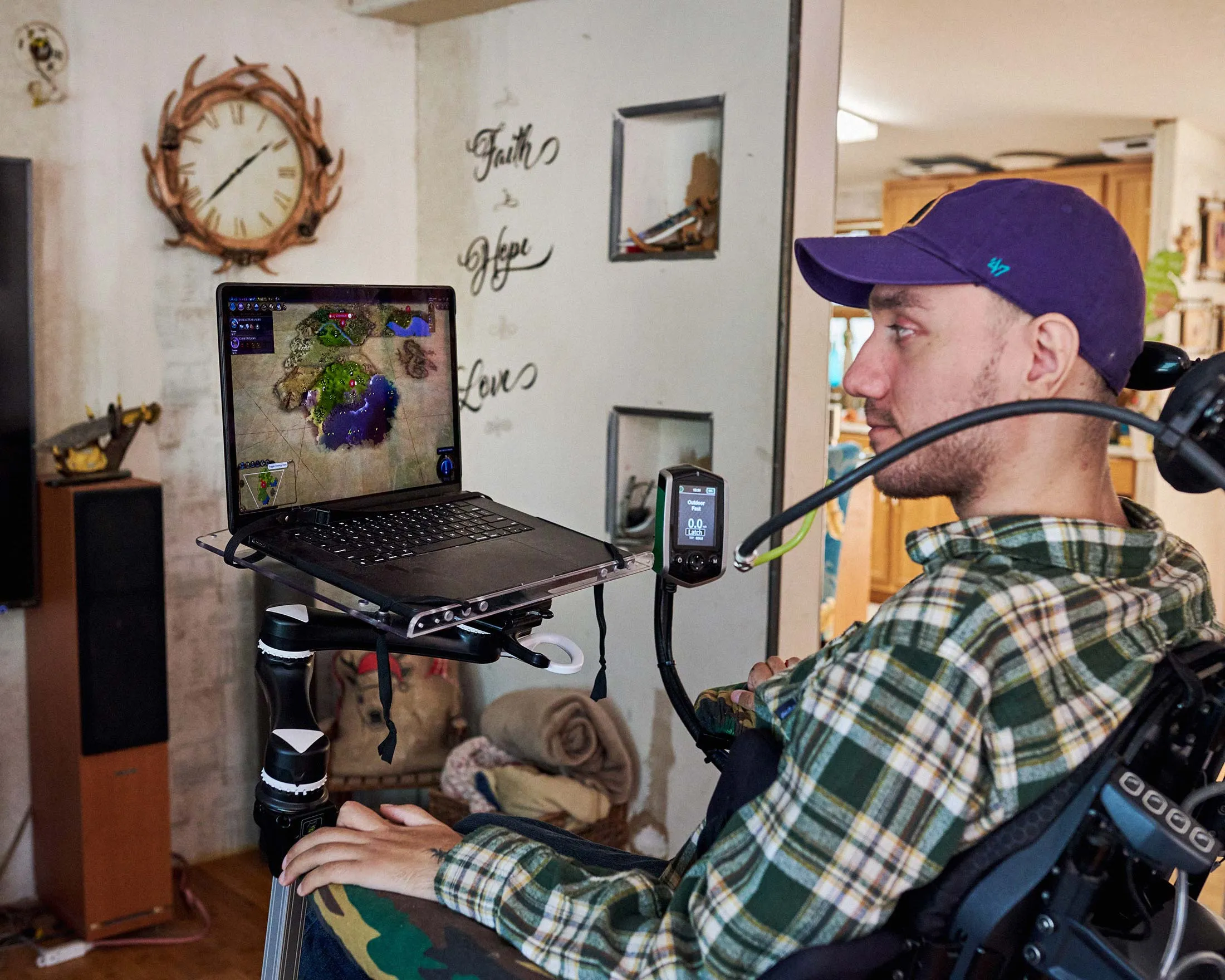
Noland Arbaugh’s journey—from a life altered by tragedy to his place at the frontier of neurotechnology—raises powerful questions about disability, innovation, autonomy, and ethics. His story is not just a milestone in medicine; it’s a mirror reflecting society’s hopes and anxieties about merging minds with machines.
1. From Loss to Leverage: Redefining Independence
Arbaugh was left quadriplegic after a swimming accident in 2016, abruptly surrendering his mobility, athletic pursuits, and independence YouTube+14Wikipedia+14The Guardian+14Facebook+5Chess.com+5stories.tamu.edu+5. Yet today, he controls a computer cursor using only his thoughts—enabling him to browse, communicate, learn languages, even play chess remotely YouTube+4Wikipedia+4euronews+4. This technological reclamation of agency underscores a seismic shift: from viewing disability as inevitable tragedy to empowering individuals through innovation.
2. Living the Trial: Motivation and Sacrifice
Arbaugh’s acceptance into Neuralink’s first-in-human study was driven by more than personal gain. He saw himself not just as beneficiary, but as collaborator—helping shape the technology for those who come after Hindustan Times+2WIRED+2WIRED+2. He’s open about the unknowns—surgical risks, “retracted threads,” and software tweaks—but willingly embraces them, driven by the promise of a future where paralysis need not be permanent New Mobility+1sisiafrika.com+1.
3. Ethics, Autonomy, and the Missing Safeguards
Arbaugh is candid about potential vulnerabilities, even joking that his implant “can be hacked” YouTube+11Hindustan Times+11New Mobility+11. Beyond jokes, his humility shines: he doesn’t claim superhuman status or fear Elon Musk’s dystopia. Instead, he highlights profound ethical dilemmas—who owns your brain data? Who can access it? Who regulates these devices once out of clinical oversight The DebriefThe Guardian? In this uncharted terrain, Arbaugh reminds us that innovation cannot be divorced from principles.
4. Normalizing the Extraordinary
Despite his chip—coin-sized, powerfully capable—Arbaugh sees it primarily as a tool. He’s learning French, playing chess online, plotting future studies, perhaps even law school euronews. The technologies competing for public attention aren’t the cyborg fantasies of sci-fi but tools of daily life: reading emails, learning languages, booking trips. He frames BCI not as spectacle but as inclusion.
5. A Cautionary Beacon for Future BCIs
Arbaugh’s early-life resilience—remaining calm under physical duress—is shaping broader neurotech discourse bigtechnology.com+6forbes.com+6sisiafrika.com+6. His transparency about thread retraction and software fixes reveals the messy reality behind the hype forbes.com+3New Mobility+3euronews+3. But importantly, his willingness to share lived experience fuels broader societal debates: about speed vs safety, regulation vs innovation, and what it means to integrate technology into selfhood.
Why His Story Matters
-
Disability as innovation frontier: Arbaugh’s role reframes disability as a locus of technological breakthroughs, not a niche concern.
-
Prototype of human-tech partnership: He’s not a passive recipient but a co-developer, shaping how future users may collaborate.
-
Ethics in real-time: His experiences surface urgent questions around privacy, consent, long-term impacts, and accountability.
-
Vision of equitable tech: His story prompts us to confront accessibility—who will benefit, who may be excluded, and how to ensure inclusive progress.
In Conclusion
Noland Arbaugh’s life reflects both the promise and perils of neurotech. His calm resilience, combined with profound curiosity and generosity, gives us tangible insight into what a future tethered to mind-computer interfaces might look—and feel—like. He reminds us that BCIs are not sci‑fi spectacle, but deeply human technologies, with all the complexity, hope, and responsibility that entails.